ABAP and SAP HANA
ABAP Programming for SAP HANA: Evolution and Opportunities

The new capabilities of SAP HANA offer a huge variety of opportunities for ABAP Developers.
Accelerate
By optimizing the coding of long-running background jobs for SAP HANA, the runtime for these jobs can be reduced. More Jobs can be executed in the same time, and particularly costly tasks are possible in one go, rather than splitting them up.
Extend
In the past, some reports had to be executed in the background, simply because their runtime was too long for dialog processing. Consequently, users worked on snapshots or pre-aggregated data sets. By optimizing these reports with SAP HANA, they can be offered as online reports again, displaying real-time data with full drill-down capability.
Innovate
With SAP HANA’s analysis and calculation capabilities, ABAP developers can design new applications that would not have been possible in the past.
A New Programming Approach
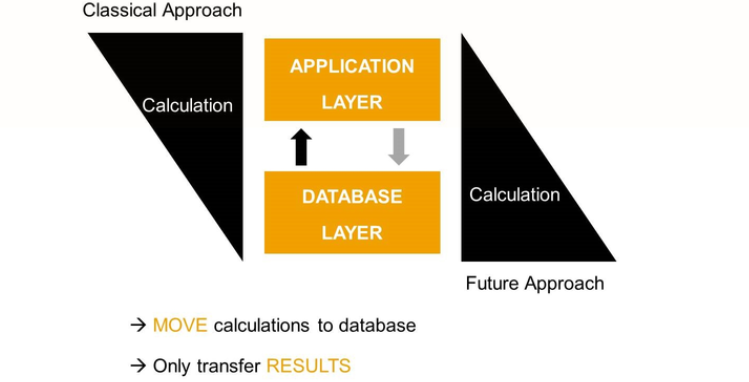
The arrival of in-memory technology on the database layer also requires a change in the way we design and implement applications. The basic approach of classic ABAP Programming was as follows:-
- Keep the load from the database
- Get all data you need on the application server
- Do your processing in ABAP
To benefit the most from SAP HANA capabilities, fundamental changes have been made in ABAP programming paradigm. It is very often referred to as “Code-to-Data”.
Bottom-Up Approach for Code-to-Data:
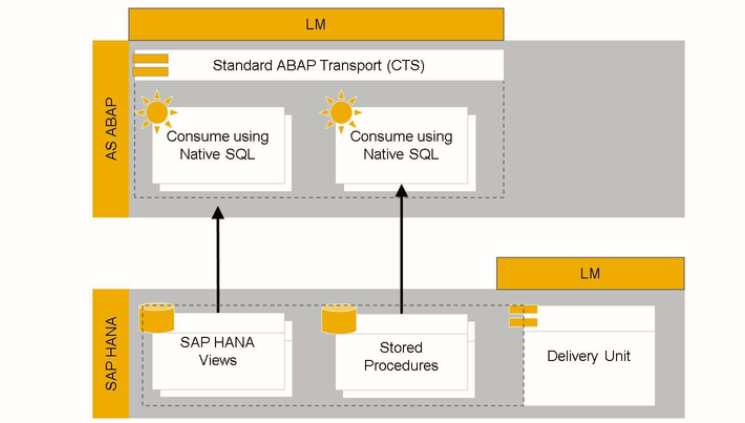
One way of approaching the code-to-data paradigm is to use native SQL to access SAP HANA specific functionality, like built-in functions. An alternative approach makes use of the fact that SAP HANA provides advanced view modelling capabilities through SAP HANA column views. Modelling such view leads to more reusable and requires less programming. If the computations are too complex to be modeled using SAP HANA views, using database procedures implemented in SAP HANA SQL script is another alternative.

Starting with ABAP 7.40 SP02, ABAP provides new repository objects to simply the bottom-up approach. These new objects are created in the ABAP repository as representatives or Proxy objects for the objects created on SAP HANA. Access to the proxy objects does not require the use of native SQL.
You can use existing SAP HANA artifacts natively in ABAP by doing the following:
- Create so-called External Views in the ABAP Dictionary to represent SAP HANA column views.
- Create so-called Database Procedure proxies in the ABAP dictionary to represent SAP HANA native database procedures.
There is also a proxy object for SAP HANA delivery units, the so-called SAP HANA Transport container. It helps to synchronize the otherwise separated lifecycle managements of ABAP objects and SAP HANA artifacts.
Top-Down-Approach for Code-to-Data

Since release 7.40 SP05, ABAP provides several additional capabilities to support the code-to-data paradigm. Transparent optimization is improvement in the ABAP stack itself. Your code directly benefits from this without any adjustments.
Using SAP HANA-specific features is improved by introducing a new concept called ABAP-Managed database procedures.