Explaining the object oriented programming model
- You can use objects to encapsulate functions and data.
- You can create multiple instances (objects).
You can perform multiple instantiations.Objects are stored in the same internal session as the program in use. All data areas are separate from each other, which keeps them protected.
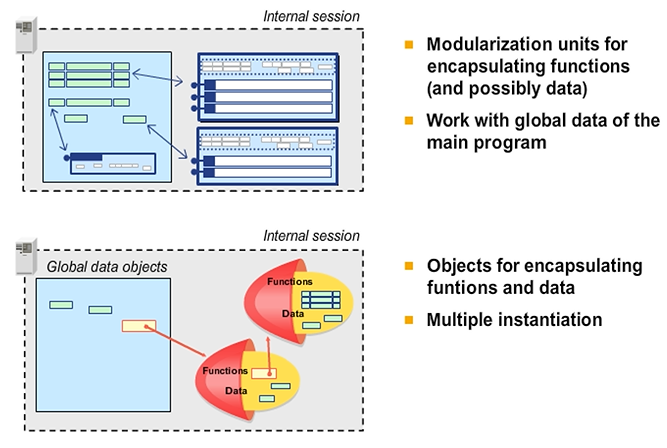
Data Management in Procedural and Object-Oriented Models
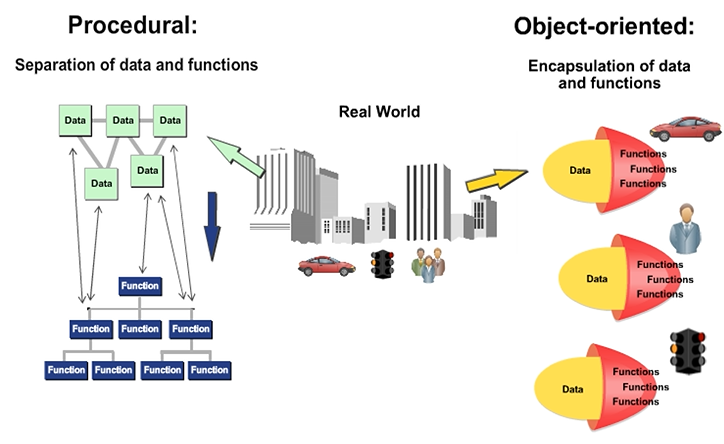
Unlike in procedural programming, using multiple instantiation in object-oriented programming allows you to create a direct abstraction of a real object. Encapsulation was systematically extended in this programming model.
ABAP Objects
The object-oriented concepts of ABAP Objects share concepts with other modern object-oriented languages, such as C++ or Java. Concepts that proved to be unsuccessful in other languages were not included in ABAP Objects. On the other hand, ABAP Objects has helpful language elements that C++ and Java do not have. Certain features of ABAP Objects only exist because of the guaranteed upward compatibility of older ABAP language elements. The difference between ABAP Objects and other object-oriented languages is the development environment. You can use the entire range of functions of the ABAP Workbench with ABAP Objects.
ABAP Objects as a Compatible Extension of ABAP
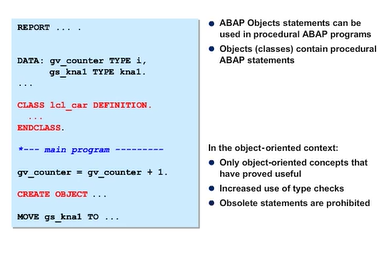
ABAP Objects is not a new language, but it was designed as a systematic extension of ABAP. All of the extensions, including the old procedural parts, are upward compatible.
Type checks in the object-oriented contexts of ABAP Objects are stricter than those in the procedural contexts.
To develop ABAP Objects, SAP cleaned up the ABAP language in the object-oriented contexts. This means that obsolete statements lead to syntax errors.
It is advisable to avoid obsolete statements in a purely procedural environment because it creates a safer and more flexible source code. However, because the language is upward compatible, it is not possible to prevent the use of such statements entirely.
For a list of obsolete language elements, refer to the ABAP keyword documentation. ABAP prohibits the use of obsolete statements in the object-oriented context.
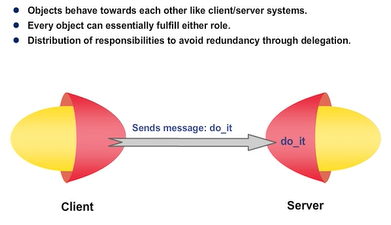
Client/Server Relationship Between Objects
To be able to separate requests and deliveries of services, the following conditions must be met:
- The client object must adhere to the protocol of the server object.
- The protocol of the server object must be clear enough for a potential client to follow it without any problems.
Objects can perform both roles simultaneously. They can offer services to other objects while requesting services at the same time.
In object-oriented programming, the services are distributed among the objects in such a way that there are no redundancies and each object offers exactly those services it is responsible for. If an object needs any other services, it requests them from other objects. This concept is known as the principle of delegation.
Additional Concepts of the Object-Oriented Programming Model
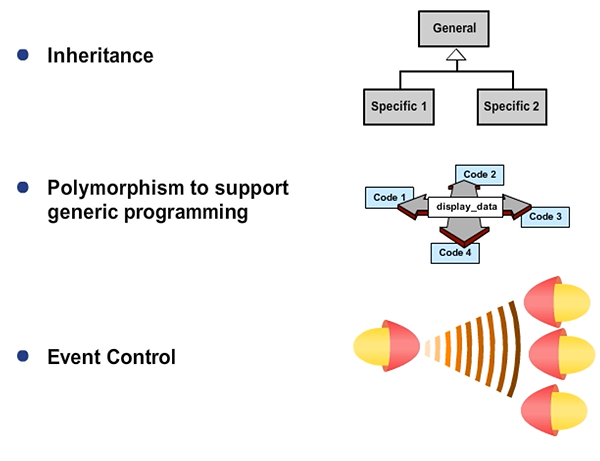
- Inheritance
Inheritance defines the implementation relationships between classes, so that one class (subclass) adopts, adapts, or extends the structure and behavior of another class (superclass).
- Polymorphism
Polymorphism is when instances of classes respond differently to the same messages.
- Event control
Instead of sending messages directly to specific objects, objects can also trigger events. Then other objects react when the event is triggered.
Object-Oriented ABAP
Key Characteristics of the Object-Oriented Programming Model of ABAP Objects
- Objects are a direct abstraction of the real world.
- Objects are units made up of data and functions.
- Processes can be implemented in a better way than in procedural programming.
Advantages of the Object-Oriented Programming Model Compared to the Procedural Programming Model