Using Standard, Sorted, and Hashed Tables
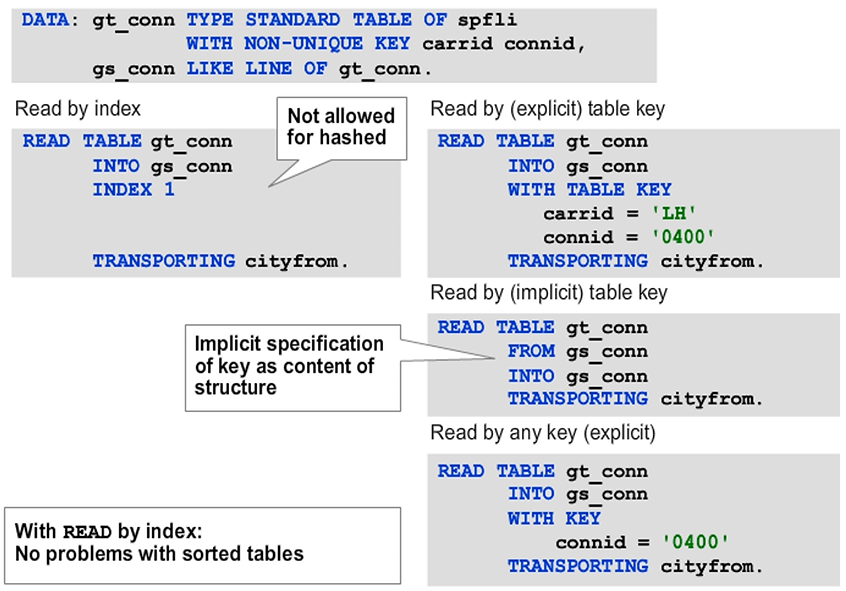
- Key is implicit
When you specify the key implicitly, the key field values are taken from the structure after the FROM addition. FROM and INTO do not need to have the same structure. - Key is explicit
When the key is specified explicitly, the full table key can be specified using WITH TABLE KEY, or any other key can be specified using the WITH KEY addition. If you use the WITH TABLE KEY addition, the syntax check demands that all of the key fields in the table are listed and supplied with a value. If a key field is missing, this causes a syntax error. If you use the WITH KEY addition, you can specify any column identifier. The syntax check does not compare them with the key fields.
The addition does not have a direct impact on runtime. When accessing sorted and hashed tables, the system uses the binary search or hash algorithm respectively, even if you use the WITH KEY addition. The only prerequisite is that you must specify all the key fields.
By using the optional TRANSPORTING addition, you can copy selected columns instead of the entire line into the specified structure defined in the program (after INTO).
Hint: If you use the special TRANSPORTING NO FIELDS addition, no data is read. Accordingly, INTO is not needed. The system looks for a line with the specified index and/or key, setting the SY-SUBRC and SY-TABIX system fields accordingly. This is an efficient way to check whether the table contains a specific line.
Single Record Write Access
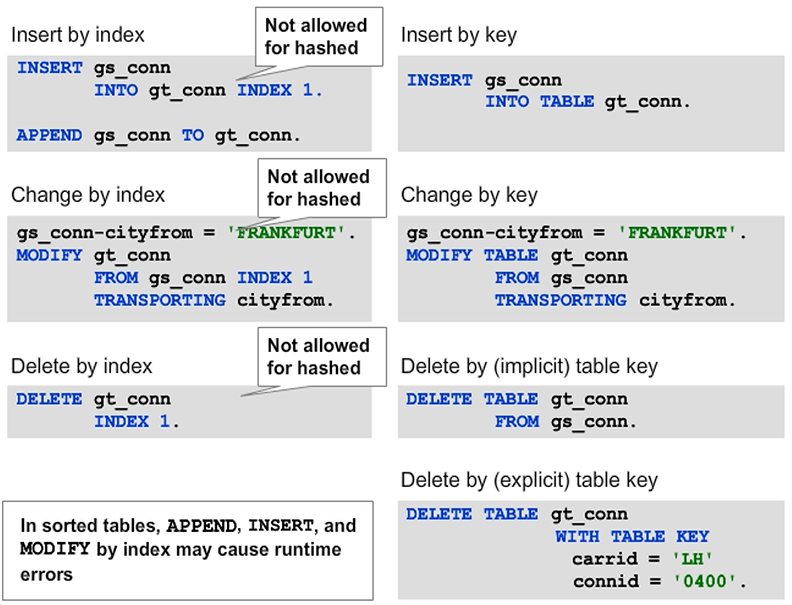
There are various ways to modify records in internal tables, depending on whether you need to add a new entry, change an existing entry, or delete an entry. The differences between index access and key access are particularly important because index access statements that modify a sorted table can cause runtime errors.
Hint: In all single record write accesses by key, the keyword TABLE appears next to the name of the internal table (that is, INTO TABLE , MODIFY TABLE , and DELETE TABLE ). You cannot use this addition for single record write accesses by index (that is, INTO lt_conn , MODIFY lt_conn , and DELETE lt_conn ). Therefore, INDEX and TABLE are mutually exclusive.
Syntax for Index Access in Loops
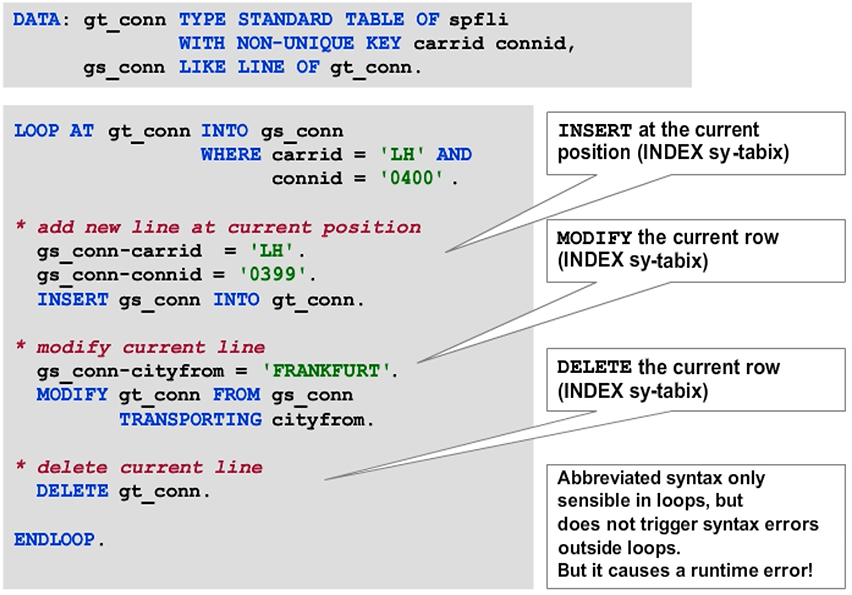
When you perform single-record write accesses by index, you can omit the explicit index specification in a loop. In this case, the system implicitly uses the current value from SY-TABIX . These syntax variants are only relevant within the loops of the corresponding internal table and can only be used there.
Caution: The constraint that these statements can only be used within loops is not verified by the syntax check. If you use them outside of loops, it causes a fatal exception (TABLE_ILLEGAL_STATEMENT).