Introduction to the ABAP Dictionary
Functional Overview of the ABAP Dictionary
The ABAP Dictionary enables all the type definitions used in the SAP system to be managed centrally.
In the ABAP Dictionary, you can perform the following activities:
- Create user-defined types, such as data elements, structures, and table types, for use in ABAP programs or in interfaces of function modules, object methods, and so on.
- Create database objects such as tables, indexes, and views in the ABAP Dictionary.
- Find many services that support program development. For example, the ABAP Dictionary supports setting and releasing locks, defining an input help (F4 help), and attaching a field help (F1 help) to a screen field.
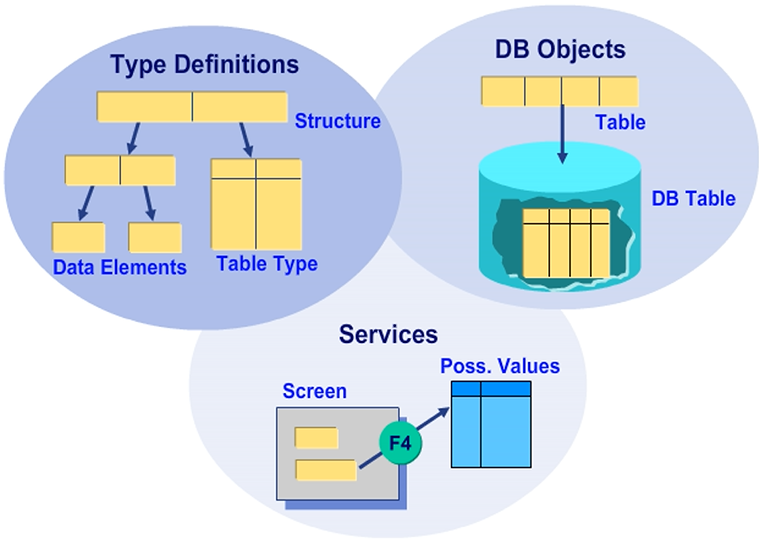
Database Objects in the ABAP Dictionary
In the ABAP Dictionary, you can perform the following functions:
- Define the tables and database views. The system creates these tables and views in the underlying database with the definition in ABAP Dictionary. Changes to the definition of a table or database view are also automatically made in the database.
- Define indexes in the ABAP Dictionary to speed up access to data in a table. The system also creates these indexes in the database when the table is activated.

Type Definitions in the ABAP Dictionary
Different type categories in the ABAP Dictionary are as follows:
- Data elements
Data elements describe an elementary type by defining the data type, length, and decimal places. - Structures
Structures consist of components that can have any type. - Table types
Table types describe the structure of an internal table.
Any complex user-defined type can be built from these basic types.
For example, the data for an employee is stored in a structure called Employee with Name, Address, and Telephone as its components. The component Name is also a structure, with First name and Last name as its components. The First name and Last name components are elementary since the type is defined by a data element. The type of component Address is a structure, whose components are also structures. A table type is used to define the Telephone component because an employee can have more than one telephone number.
Types are used in ABAP programs at various places, for example, to define the types of interface parameters of function modules.

Services of the ABAP Dictionary
The following ABAP Dictionary services support program development:
- Input helps for screen fields
Input helps (F4 help) can be defined with search help. - Field help for screen fields
Screen fields can be assigned field help (F1 help) by creating documentation for the data element. - Input check
An input check ensures that the values entered are consistent and can be easily defined for screen fields using foreign keys. - Set and release locks
The ABAP Dictionary provides support when you set and release locks. To set and release locks, you must create lock objects in the ABAP Dictionary. The function modules for setting and releasing locks are automatically generated from these lock objects; these can then be linked to the application program. - Data buffering
Performance when accessing database data can be improved for database objects (tables, views, and so on) with data buffering. - Logging
Logging allows you to record changes to the table entries automatically.
Linking to the Development and Runtime Environment
The ABAP Dictionary is actively integrated in the development and runtime environments. Each change in the ABAP Dictionary takes immediate effect in the relevant ABAP programs and screens.
The following examples explain the relationship between the ABAP Dictionary and the tools provided by the development and runtime environment: